



 1
1 0
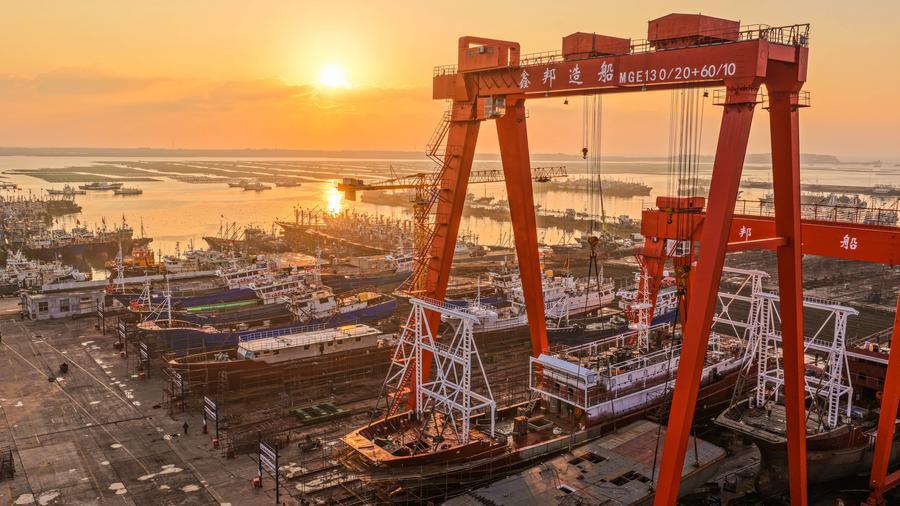
0An aerial drone photo taken on Dec. 24, 2025 shows a shipbuilding enterprise conducting shipbuilding work in Rongcheng, east China's Shandong Province. (Photo by Li Xinjun/Xinhua)Amidst rising global ...
|
Amidst rising global trade protectionism, managing director of the WEF called for utilizing multilateral mechanisms to balance healthy competition against trade barriers. DAVOS, Switzerland, Jan. 21 (Xinhua) -- Amidst persistent global geopolitical tensions and rising risks of economic fragmentation, China's transition from high-speed to high-quality development is delivering much-needed momentum and stability to the global economy, Maroun Kairouz, managing director of the World Economic Forum (WEF), has said. In a written interview with Xinhua, Kairouz described the transition as a strategic shift aimed at achieving more sustainable and resilient development, commending the structural reforms China is currently undergoing. He said that this transition reflects a focus on innovation, productivity and long-term stability. Positive signals of this shift are particularly evident in the energy sector. In 2024, China's investment in its clean energy amounted to 818 billion U.S. dollars, up by 20 percent from a year earlier. Meanwhile, the digital economy, characterized by artificial intelligence (AI), advanced manufacturing and digital services, is significantly improving efficiency across many Chinese sectors. These reforms, he said, not only strengthen China's own economic resilience but also create new global opportunities in clean energy, technology and trade for 2026 and beyond. This progress helps address shared challenges in an uncertain global environment.
Regarding "new quality productive forces," Kairouz said that China's massive investment in advanced manufacturing and green technology demonstrates how innovation can be deployed at scale. He pointed out that nearly 40 percent of the WEF's "Global Lighthouse" factories are located in China, and these factories lead the world in applying Fourth Industrial Revolution technologies to drive productivity and sustainability. The director said that China possesses one of the world's most competitive manufacturing supply chains. Consequently, developments in China inevitably have global consequences. China's strengths in green technology and advanced manufacturing play a vital role in addressing the dual challenges of climate change and supply chain instability. Amidst rising global trade protectionism, Kairouz called for utilizing multilateral mechanisms to balance healthy competition against trade barriers. Citing data from the World Trade Organization, he noted that global trade continues to grow and economies remain active in facilitating trade. Such efforts allow nations to better pursue win-win outcomes in a complex environment. Facing the transformation of the job market driven by AI and automation, Kairouz said, China's principle of integrating industrial, digital, and climate strategies with skills development offers valuable lessons for other emerging markets. The theme of the Annual Meeting 2026 is "The Spirit of Dialogue." Kairouz said that in an era of multiple global challenges, dialogue is no longer optional but is essential. The ultimate value of such dialogue lies in building trust, the foundation for global economic growth and stability.■ |
顶部


发布