



 2
2 0
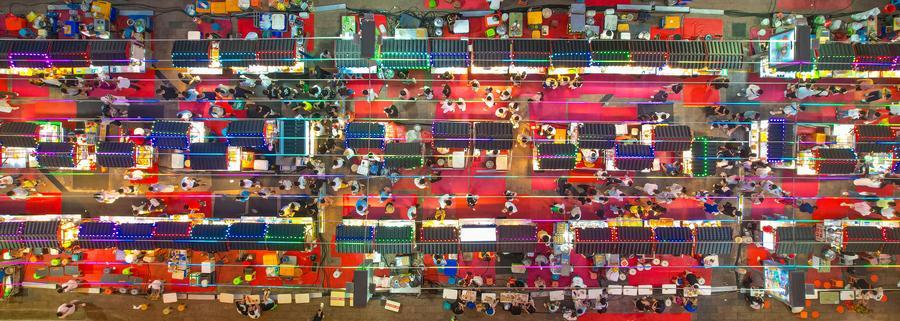
0An aerial drone photo taken on Aug. 12, 2025 shows a night market in Qingdao, east China's Shandong Province. (Photo by Zhang Ying/Xinhua)BEIJING, Jan. 21 (Xinhua) -- As night fell and lantern-shaped ...
|
BEIJING, Jan. 21 (Xinhua) -- As night fell and lantern-shaped street lamps lit up, a night market near a scenic spot in Nanjing, capital of east China's Jiangsu Province, came alive with crowds. Vendors at this venue, notably, promoted not snacks or trinkets, but jobs. College student Zhang Yijia probably would have settled for a sightseeing visit. However, she ended up securing a preliminary job offer to work as an e-commerce operator with a jewelry company, a big surprise and relief for the expectant graduate. This spot where Zhang received her first job offer serves as "a talent night market," amounting to a special job fair that stretches recruitment hours to neon-lit scenes at what first appeared to be a traditional night market. As the opening event of a pro-employment initiative that recently kicked off in Jiangsu, this market aimed at providing more flexible and efficient job hunting, allowing people to seek jobs after normal office hours. Bathed in the glow of glittering street lights, more than 50 recruitment stalls lined a stone road, offering 2,300 jobs covering various fields. Among these vacancies were high-tech posts such as big-model, robotic and AI algorithm engineers, manufacturing gigs geared to the upcoming production peak ahead of the Spring Festival holiday, and modern service opportunities catering to freelancers. Chen Wei, an official with the Nanjing municipal talent service center, told Xinhua that the event had received nearly 3,000 visitors, with more than 170 securing preliminary employment intentions. The job fair was particularly popular among young people, as the atmosphere there perfectly aligned with their social habits. In January and February, over 300 such nighttime job fairs will be held across the province to help increase access to employment, according to the provincial human resources department. Following the earlier boom of traditional Chinese medicine-themed night markets, talent night markets are now emerging as a new option for night outings for the younger generation, especially those looking for work. It is believed that the emergence of such pop-up career fairs reflects a broader shift in China's vibrant bazaars. Originally mainly featuring street foods and serving as an important driver of the country's night economy, night markets are increasingly upgrading and diversifying in a bid to provide improved and increased public services. At a summer career fair located in a commercial district in Lanzhou, northwest China's Gansu Province, fresh graduate Zeng Fangyan landed a satisfying job offer without investing much time. "In the past, I would visit night markets purely to satisfy my cravings. However, these days I can look for a job at the same time," Zeng said. The job fair featured a light-hearted vibe, an atmosphere rarely found at more conventional employment locations. Visitors, without solemn suits or formal leather shoes, simply wandered past recruitment posters, stopped by stalls and chatted with potential employers. This more casual scenario helped many to perform better in their on-site job interviews. While young people tend to prefer such job fairs thanks to the more relaxed environment, employers also see it as an opportunity to arrange interviews more efficiently in their quest to fill vacancies with suitable candidates. The recruitment stall of the jewelry company that Zhang settled on in Nanjing had received more than 10 resumes within just over 30 minutes, exceeding the expectations of Ms. Zhao in its HR department. She said nighttime recruitment was like killing two birds with one stone, as it helped them find staff members for a new chain store, while simultaneously promoting their brand. Traditional night markets have transformed into urban service hubs, which not only meet demands for a more convenient life and higher quality, but also provide new paths for the utilization of social public resources, noted Mao Jinhuang, a professor in the School of Economics at Lanzhou University. Some emerging night markets are accelerating efforts to increase their appeal. For instance, a nighttime job fair in southwest China's Chongqing Municipality has invited college graduates and other young people to gather together and simulate the experience of starting a business, while a time-honored commercial block in Lanzhou has set aside a zone where elderly people can walk their dogs, feed fish and enjoy square dancing, resulting in an increase of 45 percent year on year in its visitor flow. "The night economy is shifting from a single consumption scenario to one that integrates increased functions and focuses more on services," Mao said. It is foreseeable that all types of services related to daily life, such as legal aid, psychological counseling and skills training, could feature under neon lights at these venues, he said. ■ |
顶部


发布